

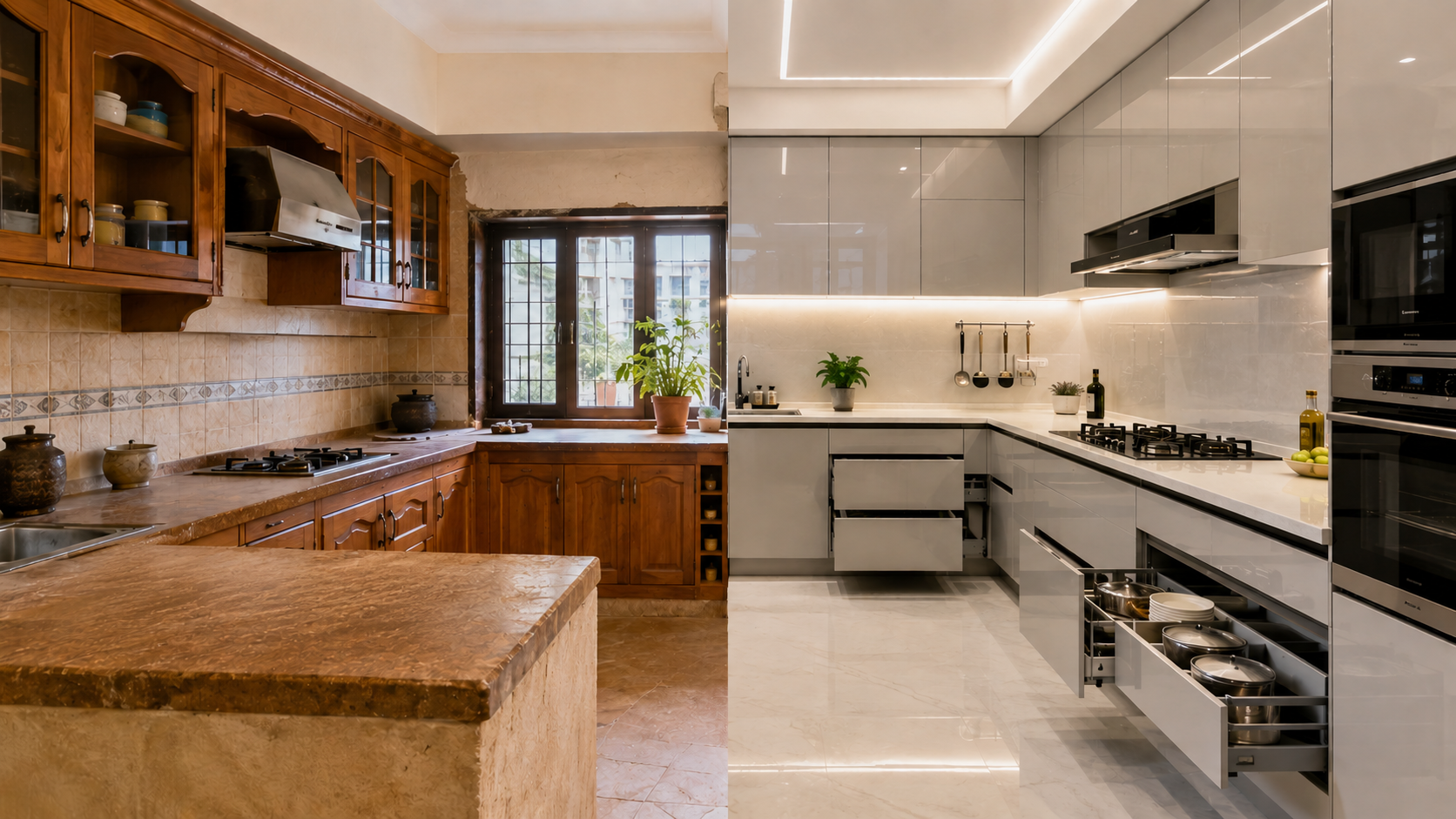
`If you have ever stood in your kitchen wondering why the cabinet doors won’t shut properly or why there is never enough counter space for your masher, spice box, and chopping board all at once, you are not alone. Kitchen renovation is one of the most common and most confusing decisions Kolkata homeowners face today.
Do you go with the tried-and-tested traditional kitchen your parents grew up with? Or do you make the switch to a sleek, modern modular kitchen design in Kolkata that Instagram and interior design reels keep pushing at you?
Both have their charm. Both have their trade-offs.
Let’s break it down honestly, so you can decide what actually fits your home, your budget, and your daily routine, not just what looks good in a showroom.
Table of Contents
What Exactly Is a Traditional Kitchen?
A traditional kitchen is the one most of us grew up cooking in. It’s built on-site, brick by brick, with masonry counters, wooden cabinets made by a local carpenter, and fittings decided as you go along. There is no fixed system, just years of practical tweaks made by the family living there.
The good part: It feels personal. It’s flexible, since you can ask your carpenter to add a shelf or change a design mid-project. And in many cases, it’s cheaper upfront if you are working with a local craftsman rather than a branded company.
The catch: Traditional kitchens take longer to build, often 30 to 45 days or more, and quality depends heavily on the individual carpenter’s skill. Storage tends to be limited, and over Kolkata’s humid months, wooden cabinets without proper treatment can warp, swell, or develop that musty smell we all know too well.
What Is a Modular Kitchen?
A modular kitchen is built from pre-fabricated units, cabinets, drawers, shelves, and countertops manufactured in a factory and then assembled in your home like a puzzle. Think of it as furniture that’s engineered specifically for kitchen use, rather than something built entirely from scratch on-site.
Every inch is planned: pull-out drawers, corner carousels, tall pantry units, built-in waste bins, all designed to make the most of even a compact kitchen.
The good part: Faster installation, often 10-15 days once materials arrive, better use of vertical and corner space, and materials specifically chosen to handle moisture and heat- a real advantage in Kolkata’s climate.
The catch: It usually costs more upfront, and any customisation after installation can be trickier and more expensive than a quick carpenter fix.
Why Kolkata’s Climate Actually Matters Here
This is the part people often skip, and it shouldn’t be. Kolkata isn’t Delhi or Bangalore; our humidity levels, monsoon intensity, and heat make material choice a genuinely practical concern, not just an aesthetic one.
Ordinary plywood and low-grade laminate can swell, peel, or grow fungus within a couple of monsoon seasons if not properly sealed. This is exactly why modular kitchen design in Kolkata leans towards marine plywood, BWP or Boiling Water Proofgrade boards, or high-pressure laminate finishes, materials built to survive humidity rather than just look good on day one.
A traditional kitchen can absolutely be built to withstand this too, but it depends entirely on whether your carpenter uses the right sealants and materials, which isn’t always guaranteed.
Cost Comparison: What You Are Really Paying For
It’s tempting to assume modular kitchens are simply “the expensive option,” but the real comparison is more nuanced.
- Traditional kitchen: Lower initial quote, but hidden costs often creep in: extra labour days, material wastage, and finishing touches that weren’t in the original estimate.
- Modular kitchen: Higher upfront cost, but it’s usually a fixed, transparent quote. What you are quoted is largely what you pay, with fewer surprises along the way.
Space Efficiency: A Bigger Deal Than You Would Think
Most Kolkata homes, especially in areas like Salt Lake, New Town, Behala, or the older parts of South Kolkata, don’t come with sprawling kitchen spaces. Modular kitchens are specifically designed to solve this problem with features like:
- L-shaped and U-shaped layouts that maximise corner usage
- Vertical storage that goes all the way to the ceiling
- Pull-out baskets and carousel units for awkward corners
- Built-in appliance slots that eliminate wasted gaps
Traditional kitchens can be designed smartly too, but it depends entirely on the carpenter’s experience with space planning, not something every local craftsman specialises in.
Maintenance and Durability Over Time
A traditional kitchen, if built with average-quality wood, may start showing wear within 5-7 years, sagging shelves, chipped laminate, or hinges that no longer close properly.
A well-executed modular kitchen, using quality boards and branded hardware, tends to hold up for 10-15 years with minimal maintenance, provided it was installed correctly in the first place.
So, Which One Should You Choose?
Here’s the honest answer: it depends on your priorities.
- Choose a traditional kitchen if you want lower upfront costs, don’t mind a longer renovation timeline, and prefer working closely with a local carpenter for a highly customised, one-of-a-kind setup.
- Choose a modular kitchen if you want faster installation, better space utilisation, moisture-resistant materials suited to Kolkata’s climate, and a cleaner, more contemporary look with long-term durability.
For most homeowners renovating today, especially in newer apartments and flats across Kolkata, a well-planned modular kitchen tends to offer better long-term value, even with the higher initial investment.
Whichever route you choose, don’t rush the decision.
Click here and get advice from experts for your kitchen.
A kitchen is something youuse every single day,and it deserves that extra bit of homework.
Frequently Asked Questions
- Which is more affordable in the long run- modular or traditional kitchens in Kolkata?
While traditional kitchens are usually cheaper upfront, modular kitchens often work out more cost-effective over time due to better durability, fewer repairs, and moisture-resistant materials suited to Kolkata’s climate.
- How long does it take to install a modular kitchen in Kolkata?
Most modular kitchen installations take about 10-15 days once the design is finalised and materials are ready, compared to 30-45 days or more for a traditional, on-site built kitchen.
- Is a modular kitchen better suited to Kolkata’s humid weather?
Yes. Reputable modular kitchen design in Kolkata typically uses marine-grade or BWP plywood and moisture-resistant laminates, which hold up significantly better against Kolkata’s humidity and monsoon conditions than standard wood used in many traditional setups.
- Can I customise a modular kitchen the way I would a traditional one?
To a good extent, yes. Modular kitchens offer plenty of layout, finish, and storage customisation during the design phase, though changes after installation are generally more limited and costlier than adjustments made with a traditional carpenter-built kitchen.